

Avidity Creative – Cedar Crest
Stone cold renderings to showcase Avidity Creative's brand design for Cedar Crest ice cream
Avidity Creative hired pkgd.design to replace flat Photoshop mockups with photorealistic 3D renders of Cedar Crest’s refreshed ice-cream packaging.
The brief: custom “frosted” renders that look cold, craveable, and consistent across seven flavor SKUs — plus environmental scenes for web and social. Every asset had to be award-submission-ready and work double duty for Avidity’s portfolio and Cedar Crest’s marketing.
Problem
2D mockups couldn’t sell cold-surface realism, and they didn’t scale across SKUs and aspect ratios. Avidity needed a cohesive, photorealistic image library — paperboard tubs under studio lighting, tactile enough to anchor portfolio pages, award entries, and brand channels without a single re-shoot.
Outcome
Using SolidWorks for geometry fidelity and KeyShot for rendering, pkgd.design delivered a unified asset set: individual SKU renders with a believable frost treatment, plus environmental scene compositions in HD wide (desktop) and vertical (social) formats. The images replaced legacy mockups on Avidity’s site, supplied Cedar Crest with ready-to-publish visuals, and served as the image backbone for design-award submissions.


Ibrance – Pfizer Rx
Calendarized holistic packaging that guides breast-cancer patients through a complex dosing cycle
Ibrance® (palbociclib) is a potent CDK 4/6 inhibitor for HR-positive, HER2-negative metastatic breast cancer. To work safely, patients must follow a strict 21-days-on / 7-days-off schedule at one of three strengths (75 mg, 100 mg, 125 mg). Early in-market bottles left many women second-guessing whether today was an on day—or if they’d already taken a tablet. Workshop interviews in Manhattan confirmed the core pain: “I dump the bottle and count backwards to be sure.”
Pfizer charged Sam with leading the structural redesign from bottle to a holistic, wallet-card-plus-carton system that makes dosing intuitive—even for patients fatigued by chemo.
Problem
Patients lacked confidence. A bottle offered no visual cue for where they were in the cycle, leading to mis-dosing risks. Any new pack also had to:
- meet F=1 child-resistance (FDA) without frustrating older or neuropathic users;
- keep all three strengths visually distinct;
- integrate clear graphics from Pfizer’s partner agency without altering structural integrity.
Outcome
Within 24 months we moved from workshop sketch to market launch (2020):
- Three wallet cards per carton, each holding seven tablets.
- A circular, start-any-day blister pattern — patients align Monday–Sunday clockwise, eliminating calendar math.
- Design-patented blister geometry — US D889,280 & US D889,282, issued July 2020.
- Passed F=1 on the first test submission for 100 mg & 125 mg; 75 mg required one tweak due to round-tablet shape.
- Pfizer’s HCP materials now highlight the pack as a built-in “dose-tracking” aid.


ZYNcoin Comfy Can
Turning a throw‑away plastic canister into a pocket‑proud premium accessory
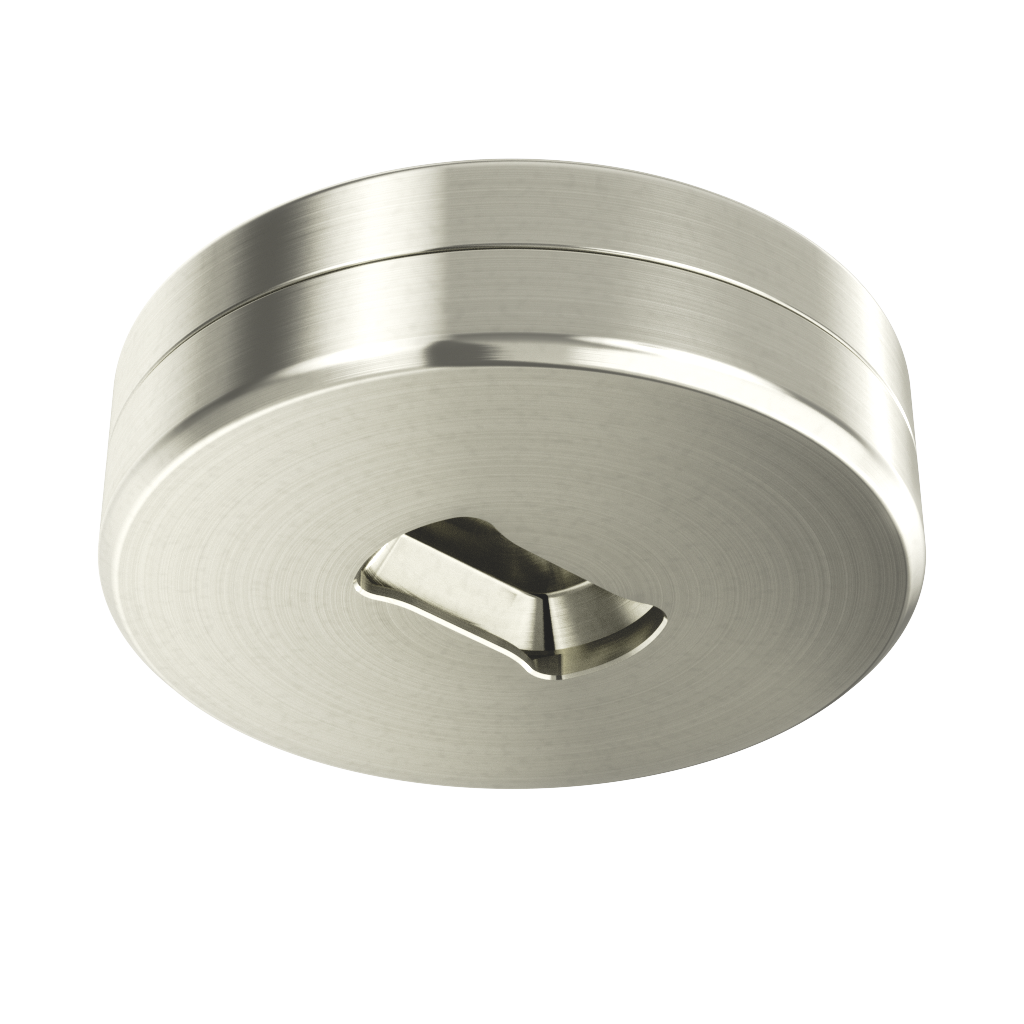
ZYNcoin wanted to give holders something real. Its in-house brand Get Comfy asked for a premium aluminum snus can — same size and capacity as the familiar plastic ZYN tin, good enough to show off, discreet enough for any pocket. And one more thing: hide a working bottle opener in the base.
Get Comfy brought the sketch to pkgd.design. The mission: turn it into supplier-ready CAD in under a week — and prove a fractional industrial design partner can outpace a traditional studio without cutting corners.
Problem
ZYN’s stock tin is injection-moulded plastic — cheap, light, made to be thrown away. Replacing it with CNC-machined aluminum raised three interlocking problems:
- Geometry paradox — the client wanted the bottle opener dead-centre on the can’s underside. Standard pry-bar openers need an exposed edge; a sealed disc has none.
- Capacity constraint — the can had to hold exactly 15 pouches. Nobody trades convenience for style.
- Weight and cost — aluminum feels premium, but every gram and every machining minute shows up in pocket weight and unit cost.
Miss any one of these and the product is a novelty — not flagship merchandise for a crypto-savvy audience.
Outcome
In five business days pkgd.design delivered two fully manufacturable versions:
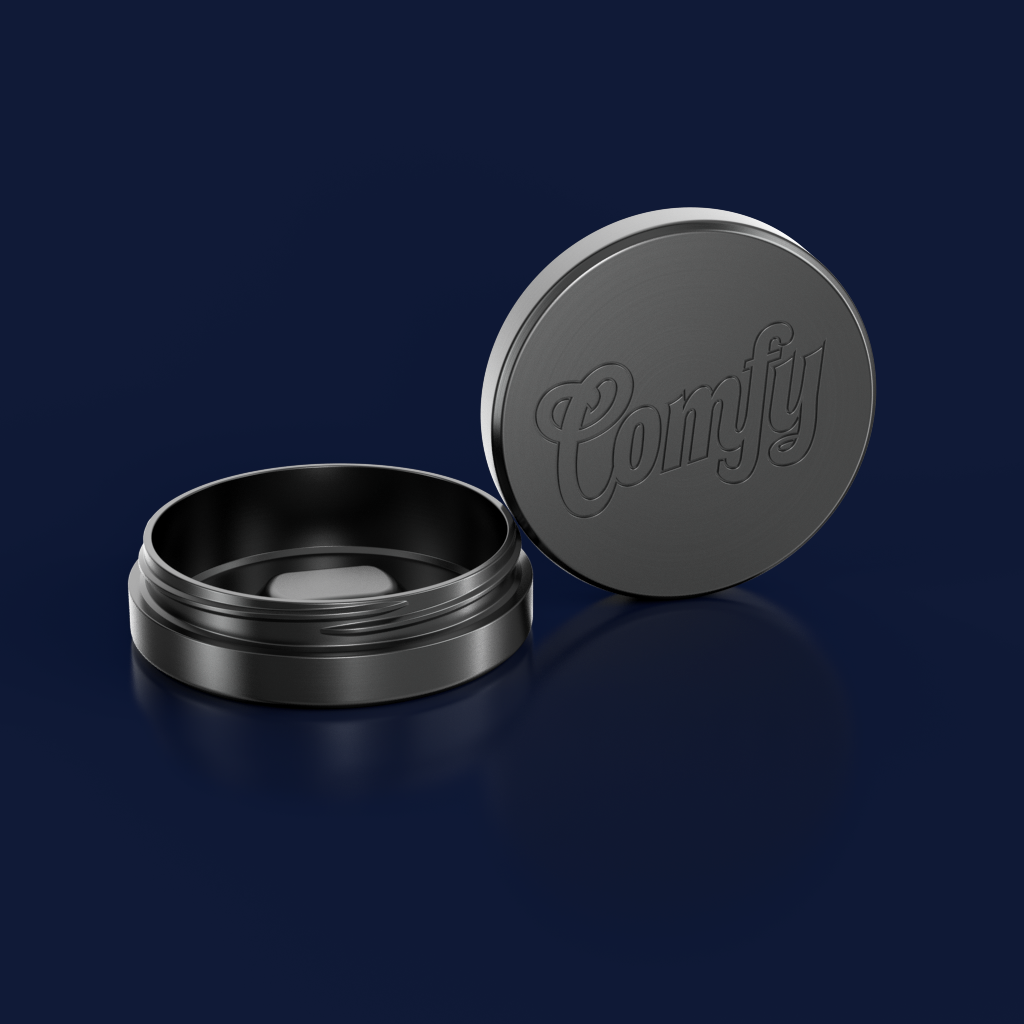
- Debossed lid – streamlined feel, lower tool wear, and the lower projected unit cost of the two options.
- Embossed lid – mirrors the client’s original concept, adding modest extra mass and machining time.
Both variants matched the original plastic tin’s outer dimensions within ±0.05 mm, retained full 15‑pouch capacity, and arrived with STEP files, cutter‑path notes, and ISO‑dimensioned drawings any CNC shop could run immediately.

Challenges
Hidden opener engineering
No off-the-shelf opener fits inside a flat disc without eating storage space, and DIY hacks all rely on side leverage — useless here. The can needed a custom opener that works vertically, survives repeated loads, and leaves the interior cavity untouched.
Material efficiency vs. tactile luxury
Premium aluminum has to feel solid and stay pocket-friendly. Using SolidWorks design-for-manufacturing mass-evaluation tools, we iterated wall thickness and rib placement until the weight settled at roughly that of a smartphone.
Timeline reality
Get Comfy runs on crypto-speed hype cycles, so we committed to a five-day sprint. Traditional packaging agencies quote 4–6 weeks for comparable DFM work. There was zero slack in the plan — and it didn’t need any.


Solution
Reverse-engineering & CAD groundwork
We laser-scanned a ZYN tin, rebuilt the mesh in SolidWorks, and assigned 6061-T6 aluminum properties to track mass, density, and centre of gravity in real time. That reverse model became the non-negotiable envelope for every concept.
Cam-based opener breakthrough
After dozens of dead-end edge-lever sketches, we flipped the question: what if the user supplies the edge, not the tin? The final design mills a kidney-shaped cam into the can’s base. Insert a bottle cap, twist 15°, and the cam forces it up and off. One solid piece, no moving parts, no weld lines. Patent-pending, filed under Get Comfy’s name.
Dual-lid strategy
Deboss vs. emboss wasn’t an aesthetic debate — it was dollars per unit. CAM simulation showed the raised-logo toolpath added meaningful machining time and cost. Presenting both options, priced, let the client launch the lean version fast and hold the embossed lid for limited-edition drops.
Supplier-ready package
Everything landed in one zipped folder:
- STEP + native SolidWorks files with feature trees
- 2D drawings with tolerance callouts, surface-roughness notes, and anodising recommendations
- CAM setup notes for three-axis mills, keeping vendor quotes transparent





Result
Get Comfy launched pre‑orders exclusively to ZYNcoin holders. The first run sold out fast, sparking secondary‑market chatter on Discord and positioning the Comfy Can as proof that Web3 brands can deliver real, tangible value — not just tokens.
"pkgd.design has exceeded my expectations on all fronts. They are extremely responsive, especially on short notice. What may have taken weeks with bigger shops was a quick five-day turnaround with pkgd.design. They're aces in my book. I am grateful for their work and I highly recommend them."

Impact at a glance
Turnaround Time:
5 business days — 8x faster than a traditional agency cycle.
First‑build success:
Prototype worked on the very first mill — no costly re‑cuts.
Material efficiency:
milled from solid aluminum — light enough for key‑chain carry, tough enough for life.

Ready to move fast? If you need industrial design that goes from idea to supplier-ready CAD in days — not weeks — book a discovery call with pkgd.design.
see how pkgd.design is right for you.
Get a guided tour of our platform and process. All we need is 15 minutes to show you the magic of design as you want it, when you need it.